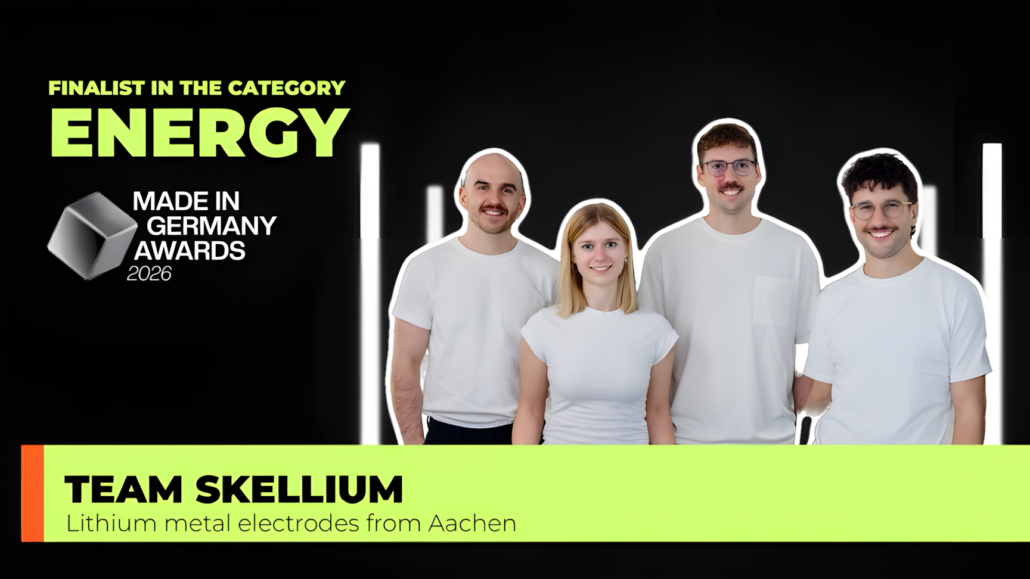
Aachen-based Skellium applies liquid lithium directly onto the copper current collector. Co-founder and CEO Gerrit Bockey on the idea behind the process, the biggest technical hurdle and the initial target market.
Around 3,860 mAh/g and the lowest standard potential of any anode material: on paper, lithium metal has ideal properties for an anode. On the factory floor, things look different. Thin lithium foils are expensive, delicate and difficult to process. Skellium, a spin-off of the PEM institute at RWTH Aachen University, therefore relies on liquid lithium and has reached the finals of the Made in Germany Awards in the Energy category.
Excerpt from the Breaking Lab video on the Made in Germany Awards (German audio, English subtitles). The full video with all three finalists is available on YouTube.
The interview
Gerrit, how did you come up with the idea for Skellium?
My background is in production engineering. At PEM, we spent a lot of time on how to bring new cell concepts into mass production, and with lithium metal I kept getting stuck at the same point. The material is there, but the thin foils you need are expensive, hard to process and in limited supply at scale. At some point the question came up: why do we first roll lithium into a foil and then laminate it onto copper, instead of applying it directly where it belongs? That is where the melt process came from, and ultimately Skellium.
What do you do differently from other approaches to lithium metal anodes?
There are essentially two established routes. You can extrude and roll lithium, or you can deposit it from the vapor phase in a vacuum. With rolling, things get harder and more expensive the thinner the foil gets. Vapour deposition delivers very thin layers, but it needs a vacuum and is comparatively slow. We apply liquid lithium onto the copper foil under inert gas and without a vacuum. This allows us to produce layers between 3 and 50 micrometers thick directly on the current collector. Our goal is to further scale up the process in web width and speed.
What benefits have you demonstrated so far?
In our comparisons, lithium plating and stripping are more uniform than with the reference materials tested. We also create 3D structures in situ during production. These structures can inhibit dendrite growth. Tests with ester-based electrolytes achieved up to 200 percent more cycles.
What was the biggest technical hurdle?
Temperature control. The layer should solidify exactly when it has reached the target thickness, and do so reproducibly across the entire web. We invested a lot of time in keeping the temperature zones in the equipment separate and controlling them precisely. Then there is the atmosphere: liquid lithium reacts not only with oxygen and moisture but also with nitrogen, so everything runs under inert gas. These may sound like minor details, but they determine the quality of the coating.
Who needs your anode first?
In the short term, we see the biggest demand in prelithiation. Silicon and graphite anodes lose lithium in the first cycle, and a defined lithium layer can compensate for that loss. That market already exists today. In the medium term, it is about true lithium metal anodes for solid-state and lithium-sulfur cells. They need exactly the thin, uniform layers we are working on.
Where do you stand today, and what is the next milestone?
We currently produce coated samples for testing on our own line in Aachen. The line produces lithium and lithium alloy anodes at speeds of up to 5 m/min under inert gas, with an adjustable surface layer. Our next milestone is a new generation of equipment, which will let us coat both sides and produce larger quantities. We build in a modular way and extend the line with every milestone instead of starting from scratch each time. That lets us respond quickly to what we learn from the cells.
And what do the Made in Germany Awards mean to you?
For a topic like ours, they offer a valuable opportunity. Breaking Lab explains technology in a way that people outside the industry understand too, and that rarely happens with battery production.
How to vote
- Link: madeingermanyawards.de/voting/energie
- Voting period: until November 10, 2026, 11:59 pm (CET)
- Important: click the link in the confirmation email, otherwise your vote will not count
- Winners: November 23, 2026, 8 pm (CET), live on Breaking Lab on YouTube
About Skellium
Skellium is a spin-off of the PEM institute at RWTH Aachen University. The company develops lithium metal electrodes and the corresponding production technology for next-generation battery cells.