
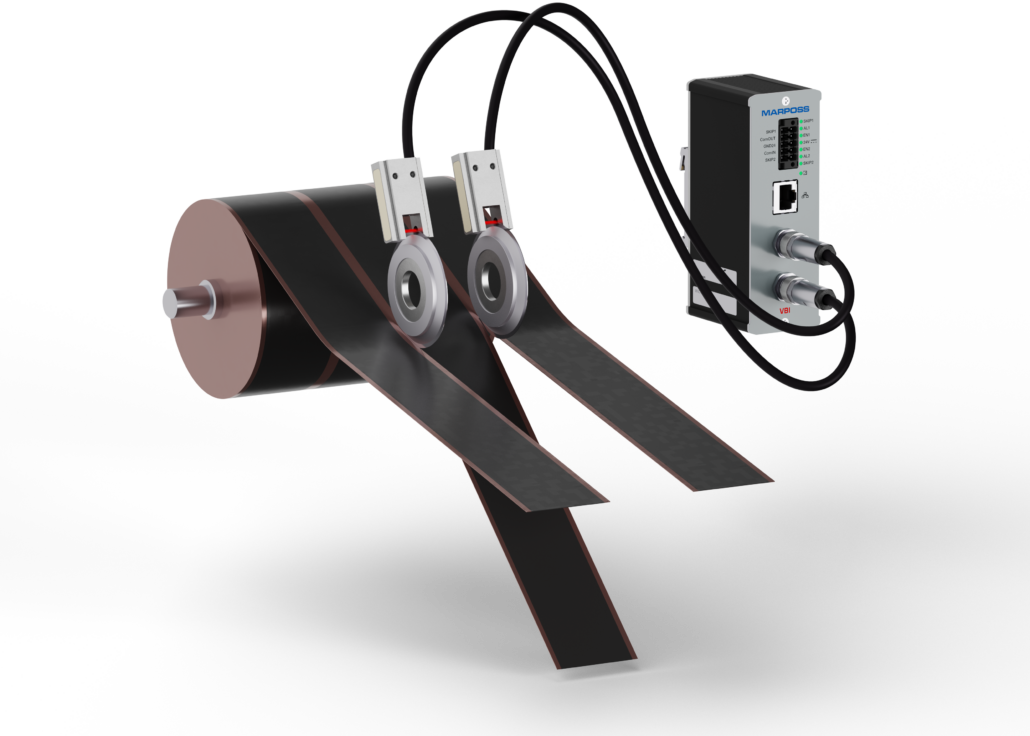
Damaged cutting tools can compromise the quality of battery electrodes and, in the worst case, pose safety risks. Marposs GmbH has developed a sensor-based solution that detects tool damage in real time during the cutting process. According to the company, the system is already in use in production at a German battery cell manufacturer.
Cutting battery electrodes requires high precision. Even minor damage to cutting tools can affect electrode edge quality, both when slitting coated electrode webs and when notching electrode tabs. Worn or blunt blades can cause burrs, loose particles or delamination, in which the active material coating separates from the metal substrate. In the worst case, such defects can lead to internal short circuits and thermal incidents in the finished cell.
Andreas Leichsenring of Marposs GmbH explains that wear, minor damage and chipping are inevitable when cutting tools are used over many kilometres of cutting length.
Continuous monitoring of tool condition
Cutting tools in electrode manufacturing are often replaced at fixed intervals or checked manually through spot inspections under a microscope. As a result, a damaged blade can remain undetected until the next inspection and produce defective electrodes.
Marposs uses optical sensors to monitor the cutting process directly in real time. The sensors are installed close to the cutting edge, typically in the blade holder or drive. According to the company, the system reliably detects chips in cutting edges as small as ten micrometres. To reduce false alarms caused by process variations, the data analysis uses mapping to account for different web speeds and blade rotational speeds. If a threshold agreed with the customer is exceeded, the system can stop the machine within a few milliseconds or issue a warning, the company says.
Deployment at a German cell manufacturer
According to Marposs, the solution is ready for series production and is already in use in anode and cathode manufacturing at a German battery cell manufacturer. It was integrated into existing production lines, with minor modifications to the blade holders for the retrofit. The sensors’ compact, U-shaped design is intended to facilitate integration into existing equipment.
As Michael Unterste of Marposs explains, data from different tools initially collected during test runs was analysed and compared with the results of manual inspections and optical microscopy. The data analysis was then adapted to the specific application.
Marposs says the system can also be connected to existing manufacturing execution systems (MES). This allows monitoring data to be incorporated into production control and quality assurance.
Economic benefits and use during production ramp-up
Condition-based monitoring is intended to align tool changes more closely with the actual condition of the cutting edges. This can help avoid replacing blades prematurely as a matter of routine or continuing to use them despite damage. Marposs reports less scrap and reduced labour requirements for manual visual inspections in practical use. Cell manufacturers can also use the collected data to compare the service lives of different blades and draw conclusions about the quality of tool suppliers.
Marposs sees production ramp-up as another application: if the sensors are used during testing at the machine builder’s premises, the measurement data can help in selecting suitable cutting tools and cutting parameters. In Michael Unterste’s view, this can lay the groundwork for a reliable production ramp-up before the machine is handed over.