
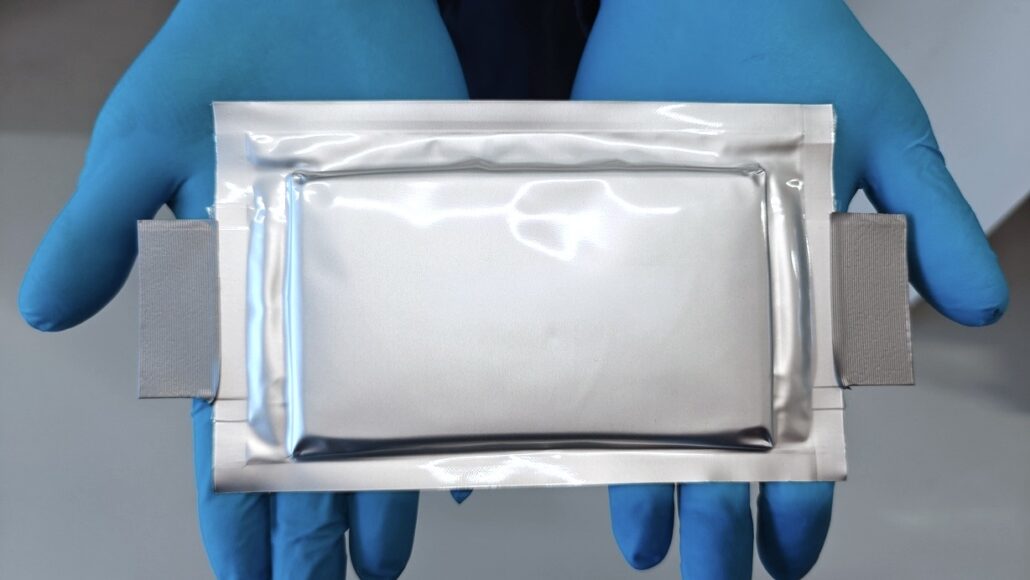
Fraunhofer ISE has tested battery cells made in-house with silicon-rich anodes for more than 1,000 full cycles. According to the institute, they retained over 83% of their original capacity afterward. An external compression pressure of 1,000 kilopascals was a key factor. The research cells achieve an energy density of 280 watt-hours per kilogram. For an industrially optimized cell format, the institute expects approximately 330 watt-hours per kilogram.
Silicon-rich anodes promise higher energy densities for lithium-ion batteries. This makes them attractive for electric mobility, aerospace, and stationary energy storage. However, their limited lifespan has so far hindered industrial adoption.
Compression Pressure Affects Cycle Life
In the StrOboBatt project, researchers compared two axial compression pressures: 300 and 1,000 kilopascals. The cells were charged and discharged in one hour each. At 1,000 kilopascals, they retained the reported capacity after more than 1,000 full cycles. Under the lower pressure, usable capacity declined more sharply. External pressure can improve electrical contact and reduce the separation of electrode materials.
As the cycle count increased, the gap also widened between the remaining capacity measured at a low discharge rate and the capacity available during regular operation. Potential applications therefore require an assessment of performance under the relevant operating conditions.
Industry-Relevant Cell Format With a Silicon-Carbon Anode
The tested pouch cells have 40 layers and a capacity of 25 amp-hours. They combine a silicon-carbon/graphite anode with a nickel-rich nickel-manganese-cobalt oxide cathode. The silicon-carbon composite accounts for 51% of the anode’s active material. The cells were manufactured on a semiautomated line at Fraunhofer ISE. They serve as a reference for investigating new materials, cell designs, and operating conditions.