
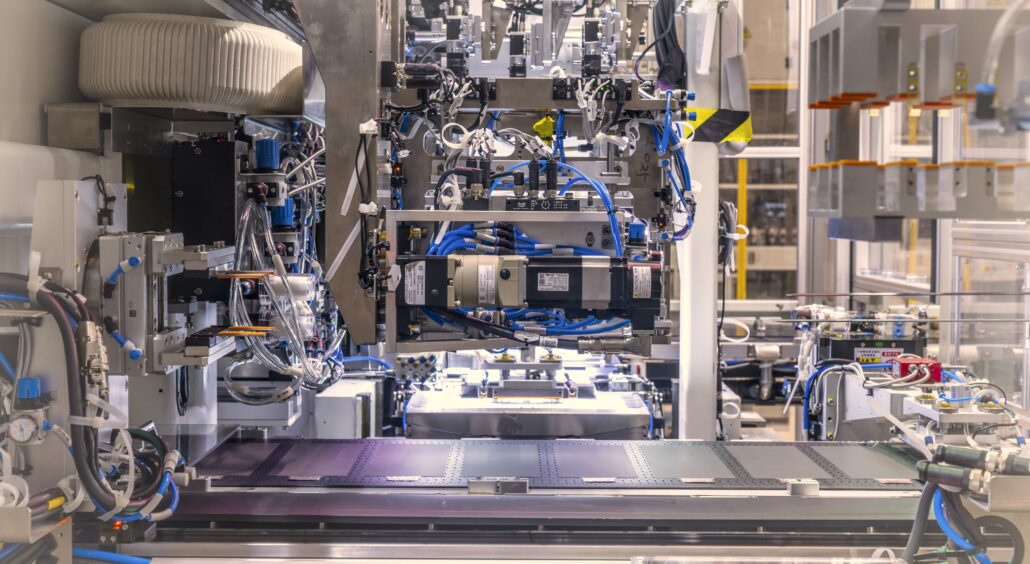
Four German industry associations are calling for stronger political support to establish a competitive battery industry. KLiB, VCI, VDMA, and ZVEI point to shortcomings in scaling and the transition from research to industrial mass production.
The statement was released in conjunction with the topping-out ceremony for the Fraunhofer Research Institution for Battery Cell Production on July 13, 2026. According to the associations, Germany has the necessary research expertise, specialized companies, and substantial industrial demand. Nevertheless, companies often struggle to enter the market.
Associations Criticize Insufficient Conditions for Scaling
The associations identify structural disadvantages at the national level and inadequate conditions for ramping up production as the main problems. Research results alone do not automatically lead to industrial value creation.
They are therefore calling for more targeted industrial policy instruments. These measures should be more closely aligned with the needs of emerging industries. Without suitable conditions, expertise, patents, and production capacity could shift to other regions of the world. The support announced in the government’s program for economic growth and employment must now be defined in concrete terms.
Battery Dependence Affects Multiple Industries
According to the associations, global battery demand has increased by an average of 43 percent per year over the past five years. Batteries are used in electric mobility, energy supply, data centers, rail technology, robotics, space applications, and other sectors. The associations therefore warn of growing dependence on suppliers outside Europe.
They see particular risks for critical infrastructure and defense technology. They believe that strengthening European battery production would bolster supply chains and reduce technological dependence.
Source:
https://klib-org.de/pressemitteilung-klib-vci-vdma-zvei/