
Europe’s battery industry is entering a decisive phase. On June 9, 2026, the European Commission established the Battery Booster Facility, mobilizing up to €1.5 billion in interest-free loans to help cell manufacturers ramp up production across the European Economic Area.
Germany illustrates both the promise and the difficulty of that ramp-up. Volkswagen’s PowerCo began cell production at its Salzgitter gigafactory in late 2025. At the same time, several announced projects have slowed or become uncertain: the planned expansion of CATL’s Erfurt site remains unclear, ACC’s Kaiserslautern project has been put on hold, and the outlook for Cellforce’s plant in Schwarzheide is uncertain. Fraunhofer ISI expects Europe’s battery cell production ramp-up to continue to face significant challenges.
At the same time, demand keeps climbing: Germany’s vehicle fleet passed 2 million battery-electric cars in January 2026, and 2025 closed with a record 545,142 new BEV registrations — a 43% increase over the previous year, according to the Federal Motor Transport Authority (KBA). This combination between rising demand and an uneven production ramp-up is exactly why cost and energy efficiency in cell manufacturing matter now more than ever.
One process step, outsized impact
One of the most effective levers for cost and energy efficiency in cell production lies in a single processing step: cathode drying. It alone accounts for up to 45% of total energy consumption in a dry room — and offers the biggest potential for saving energy, increasing yield, and improving cell quality. Getting it right means controlling extreme conditions: temperatures up to 160°C, aggressive NMP solvents, and ultra-dry environments where small measurement errors quickly become expensive ones.
That challenge is the focus of an on-demand session from measurement specialist Vaisala.
What the webinar covers
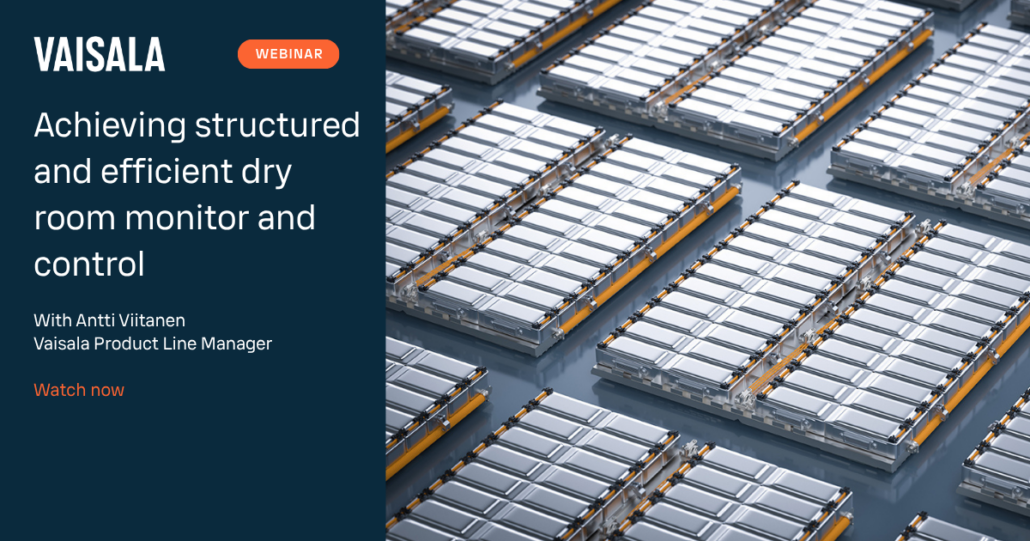
In a free, 30-minute webinar (in German), Vaisala expert David Dlugay walks through how manufacturers can optimize cathode drying under these conditions while avoiding costly downtime.
Attendees will learn:
- Why dew point is the ideal measurement parameter for controlling and optimizing the drying process
- How to manage high temperatures and aggressive chemicals with reliable in-situ measurement
- Best practices for installation, accuracy, response time, and uptime
Who should watch
The webinar is aimed at rechargeable battery manufacturers, midstream production stakeholders, dry room operators, and anyone shaping the future of European battery manufacturing.
Register now and watch on demand: Efficient Cathode Drying in Battery Manufacturing | Vaisala