
About half of the spent lithium-ion batteries collected from power tools are not deeply discharged. Yet only a small share can currently be refurbished economically. The EASLi research project examined which recovery route makes sense for different batteries—and found that earlier, more effective sorting is key.
Led by Stiftung GRS, a consortium of companies across the battery value chain and end-of-life management sector examined the technically and practically viable options for spent nickel manganese cobalt (NMC) lithium-ion batteries from power tools. Project partners included Robert Bosch Power Tools, Gemeinsame Rücknahmesystem Servicegesellschaft mbH, Battery Damage Service (BDS), Erlos Produktion und Montagen GmbH, and ECOLOGICON GmbH. The German Federal Environmental Foundation (DBU) funded the project from January 2025 through February 2026.
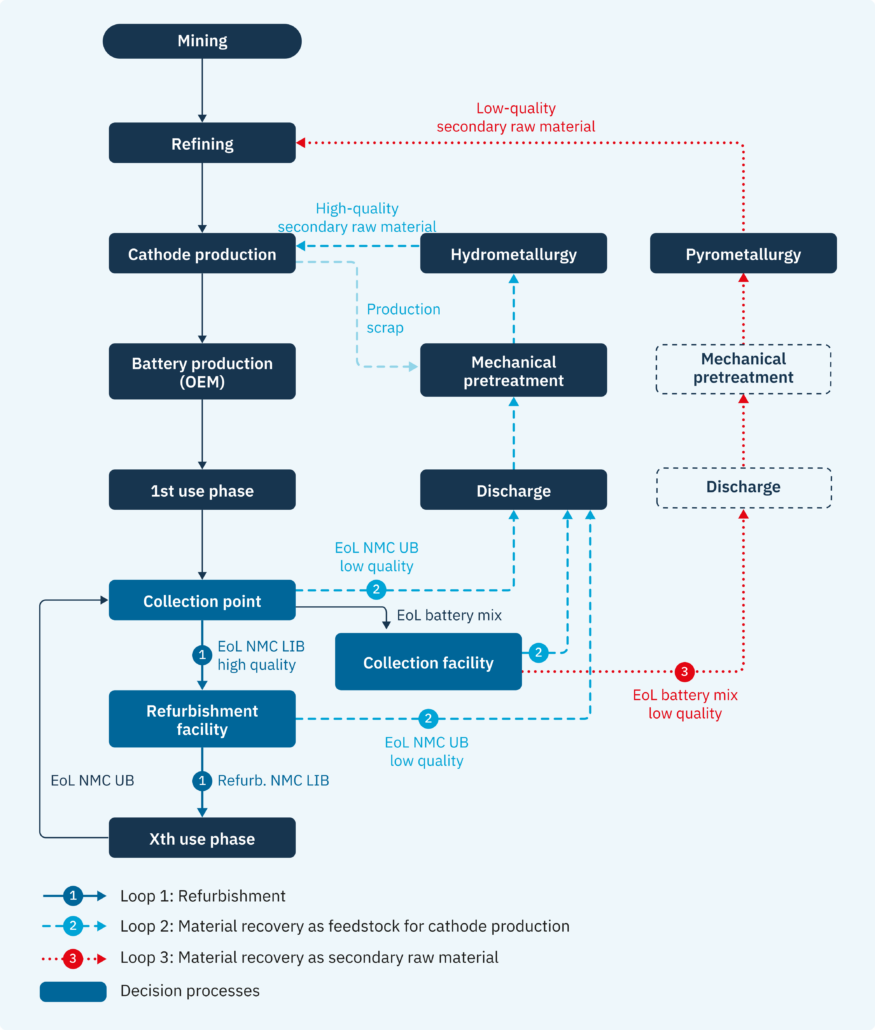
The work focused on three pathways: refurbishing batteries for a second service life (Loop 1); high-value hydrometallurgical recycling that can return recovered materials to cathode production (Loop 2); and pyrometallurgical processing to recover lower-grade secondary raw materials (Loop 3).
What comes back through collection systems
Three sorting campaigns examined more than four metric tons of material collected at take-back sites, including recycling centers and home improvement stores. Lithium-ion batteries accounted for approximately 55% of the power tool batteries examined. Nickel-cadmium (NiCd) batteries still made up 37% of that fraction, reflecting the continued return of older products—even though NiCd batteries have been prohibited in power tools placed on the market since 2017.
The high NiCd share illustrates how long power tool batteries can remain in circulation. For the roughly one-quarter of batteries with an identifiable manufacturing year, the average time between manufacture and collection was about ten years. The oldest dated back to 1989. Batteries used by private consumers were returned after approximately eight years, compared with about four years for those used commercially.
Technical potential remains
Overall, around 70% of the sorted power tool batteries were deeply discharged, a figure driven largely by older NiCd batteries. By contrast, about half of the lithium-ion batteries were not deeply discharged, and newer batteries tended to retain a higher state of charge. In other words, today’s recycling stream includes batteries that may not have reached the end of their useful technical life and could warrant further evaluation for reuse or second-life applications.
To assess how many batteries might actually qualify for reuse, BDS tested 265 used 18-volt battery packs. The evaluation process ranged from visual inspection and pack- and cell-voltage measurements to state-of-health (SoH) testing through charge-discharge cycling. The findings were sobering: 62% of the packs were deeply discharged, and more than one-third registered below 4 volts—an indication of potentially irreversible cell damage. The subsequent SoH assessment examined two distinct return streams: one closely linked to a manufacturer and another collected through a take-back system. In the respective subsamples, 30% and 11% of the battery packs were deemed suitable for reuse. Because those subsamples comprised only 64 and 19 packs, respectively, the findings cannot be considered representative of either return stream as a whole.
Why reuse has yet to become a viable business model
Low reuse rates pose a major challenge to economic viability. Under the study’s scenario, which assumed German labor costs, the expense of testing and measurement equipment would likely exceed the revenue generated by reselling reusable battery packs. According to the final report, making the process commercially scalable would require more targeted presorting, automation of individual testing steps, or different terms for acquiring used batteries.
Regulatory obstacles add to the challenge. When end users discard batteries for disposal, those batteries are classified as waste and may be transferred only to certified waste-management companies. Power tool manufacturers generally do not hold the relevant certifications. Questions also remain about liability, warranties, and the branding under which refurbished batteries could be sold. In addition, uniform standards for testing and reuse are lacking.
Battery design presents another obstacle. Power tool battery packs are engineered for durability and safe operation, not easy disassembly. Adhesives and a wide range of materials make refurbishment more difficult. The project’s final assessment is therefore cautious: second-life applications are technically feasible, but significant regulatory, practical, and economic barriers continue to prevent widespread adoption.
High-value recycling is likely to handle the largest share
The project team expects most end-of-life NMC power tool batteries to enter Loop 2, provided that sufficient identification and sorting capabilities are available. Refurbishment is expected to account for the second-largest share, with pyrometallurgical processing handling the smallest.
Trials conducted by ERLOS yielded practical findings for Loop 2. Because battery management systems generally prevent complete discharge, the company tested a wet-discharge process that reduced battery-pack voltage to below 1 volt within 24 hours. Adding a zinc salt reduced corrosion. The trials also indicated that mixed batches of NMC and nickel cobalt aluminum (NCA) batteries can be directed into the same hydrometallurgical recycling stream under Loop 2. For process quality, contamination from materials such as plastics and electrolyte residues matters more than the precise cathode chemistry. This makes early separation of lithium-ion batteries from other battery types particularly important.
Three decision points instead of one matrix
EASLi originally set out to develop a multicriteria assessment system to identify the optimal recovery route for each battery. Over the course of the project, however, it became clear that such a matrix would be of limited practical use: collection sites, sorting facilities, and refurbishment companies have access to different information and face different operational decisions.
The team instead developed decision trees for three points along the process where those decisions are actually made. At a collection site, basic questions can guide an initial assessment: Can the battery chemistry be identified? Is the housing damaged or contaminated? Are the contacts intact, and is the manufacturer identifiable?
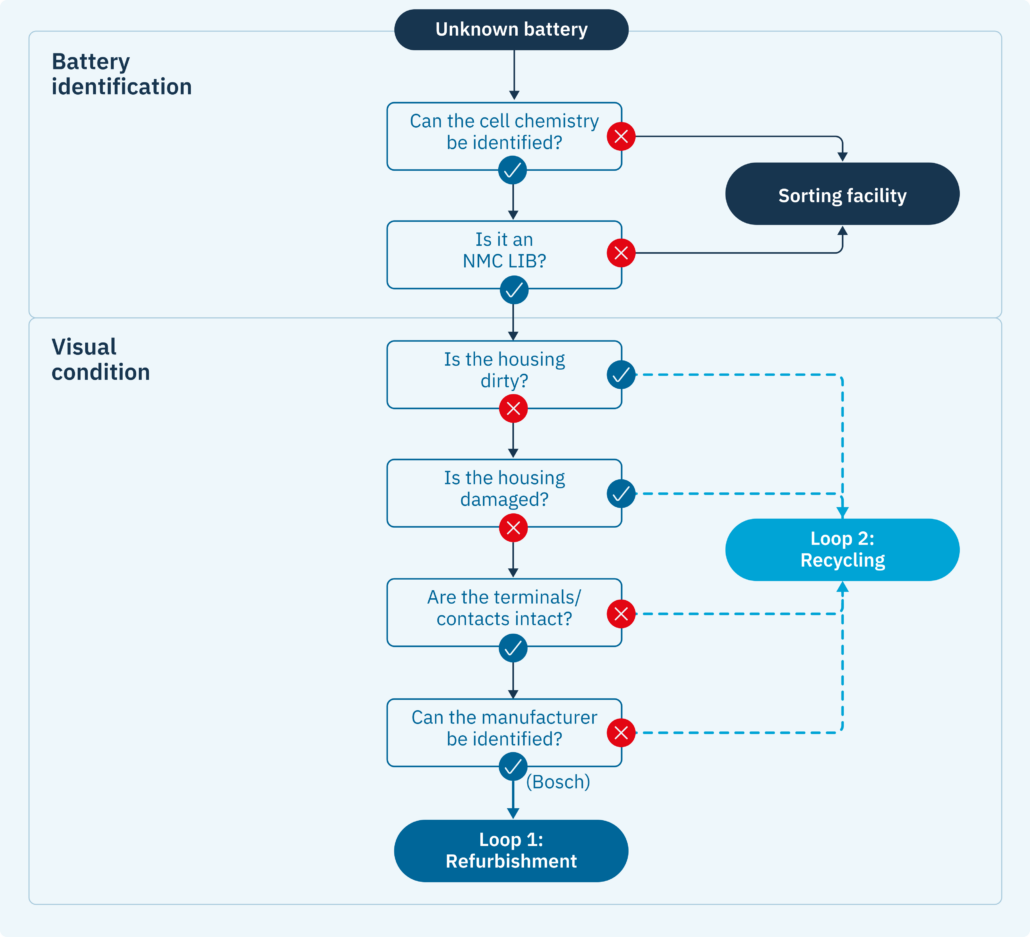
Sorting facilities distinguish between battery chemistries, while refurbishers additionally assess state of charge and SoH. The approach is intended to help smaller companies direct batteries toward appropriate recovery pathways without extensive data collection.
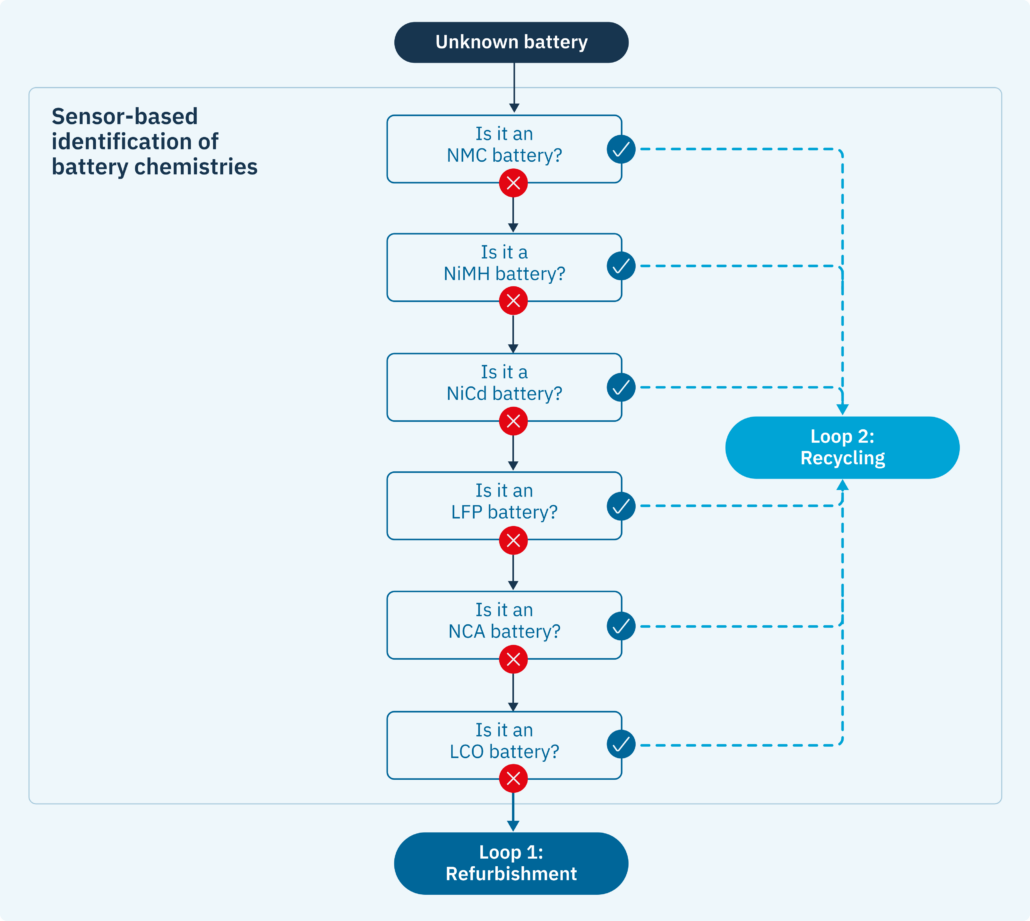
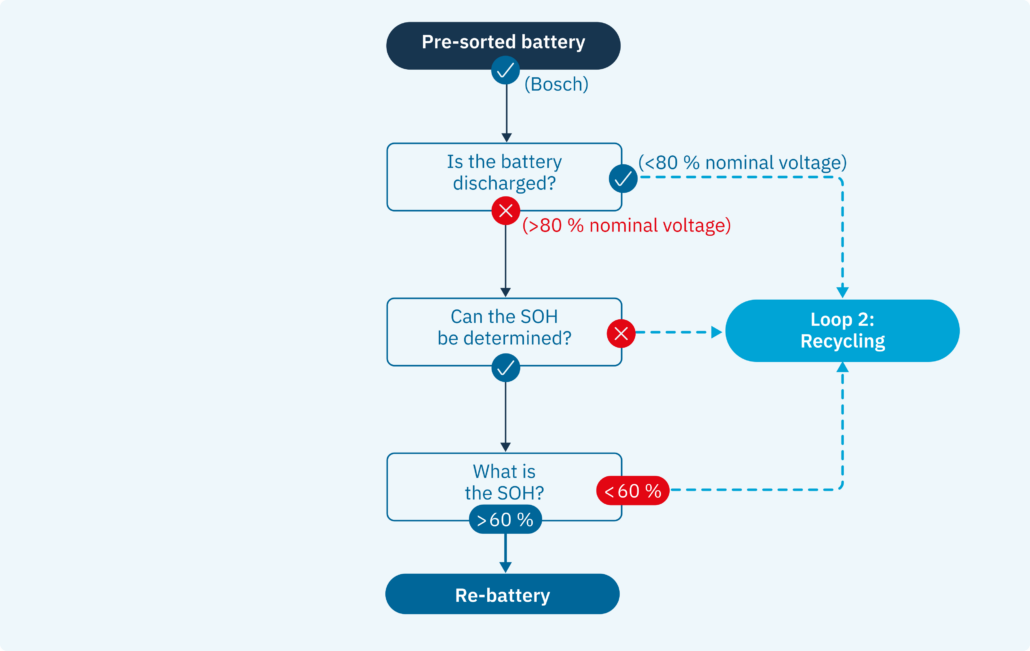
EASLi thus addresses an often-overlooked aspect of battery recycling: the quality of recovered materials depends not only on the recycling technology itself, but also on how batteries are handled before recycling begins. High-value circularity starts with the information available about each battery and how early different material streams are separated.
Better data could make the difference
The project sees further potential in improved data availability and automated identification. A digital product passport or QR code could provide information on the manufacturer, battery chemistry, capacity, and date of manufacture. Such a passport is not mandatory for power tool batteries, however. Starting in February 2027, the EU Battery Regulation’s digital battery passport requirements apply to electric-vehicle batteries, light means of transport batteries, and industrial batteries with a capacity greater than 2 kWh—not portable batteries. Camera-based artificial intelligence systems could also identify battery types and assess their external condition. The project outlines an app concept that would use a photograph to help determine whether a battery should be routed toward reuse or recycling.
EASLi does not suggest that second-life applications will displace recycling for power tool batteries anytime soon. Instead, its findings point to a more differentiated approach to circularity: identify batteries that can remain in use, sort out unsuitable units early, and process the remainder so that the highest-value possible materials can return to battery production.