
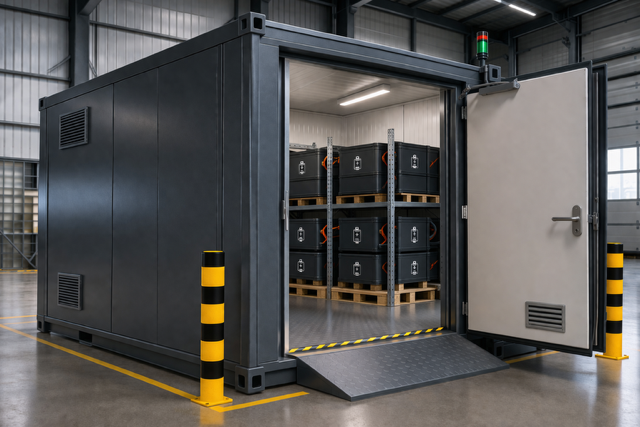
Lithium-ion batteries have become indispensable in modern industrial facilities. At the same time, they present intralogistics with growing safety requirements. The key point here is that the potential for danger is not constant; rather, it depends heavily on the battery’s current condition. The operational state of the cells significantly determines how high the risk of thermal instability in the warehouse should be assessed.
A thorough understanding of internal processes is the foundation of any robust fire protection concept. The structure of lithium-ion cells explains why: The high energy density poses significant risks in the event of a failure. In particular, the separation of the anode and cathode by the separator is a critical point—if this barrier is damaged, internal short circuits can occur.
State of charge as a key risk factor
The state of charge (SOC) is considered one of the most important parameters for the safety of stored batteries. The higher the energy content in the cell, the more intense a potential reaction will be in the event of damage.
In practice, therefore, storage at a moderate state of charge of about 30 to 50 percent has become standard. In this range, reactivity is significantly reduced.
A fully charged battery, on the other hand, poses the highest risk of thermal runaway: The chemical voltage is at its maximum, so that an internal short circuit can lead to an abrupt release of energy.
“In practice, we see time and again that it is not the battery itself that poses the risk, but its condition at the time of storage,” says Paul Fricke of Protecto. “High states of charge or cells that are already damaged significantly increase the likelihood of critical events.”
To better control these risks, many companies now rely on automated monitoring systems that continuously monitor the state of charge during storage.
Aging, pre-existing damage, and dendrites: How cells become unstable
In addition to the current state of charge, the overall state of health (SOH) plays a central role. As aging progresses, the likelihood of internal defects increases.
A key mechanism here is the formation of so-called dendrites: fine, needle-like lithium structures grow on the electrodes. Over time, these can penetrate the separator and trigger internal short circuits—a gradual process that can significantly compromise the cell’s safety.
Additional factors also affect cell integrity:
- Mechanical stress: Microcracks in the casing or deformation caused by impacts
- Thermal history: Previous overheating permanently weakens the cell chemistry
- Chemical instability: Electrolyte decomposition resulting from deep discharge or overcharging
The storage of batteries that already show signs of abnormalities is particularly critical. A swollen casing or unusual heat generation are clear warning signs. Such units should be immediately separated and isolated in suitable fire-resistant containers to prevent the spread of fire.
Environmental influences in warehouse operations
Environmental conditions also have a direct impact on the risk profile. High temperatures accelerate aging processes and lower the threshold for thermal reactions.
Professional warehouse management therefore ensures that batteries are stored in climate-controlled areas without direct sunlight. The goal is to consistently minimize external stress factors.
Monitoring and preventive analytics as the key
Continuous monitoring is a central component of modern safety concepts. Monitoring cell voltage and temperature makes it possible to detect critical developments early on.
Telemetry data is evaluated in real time to identify trends—such as gradual heating—at an early stage. This allows potential risks to be addressed before a damage event occurs.
Emergencies require expertise and clear procedures
Technical systems alone, however, are not sufficient. Safe handling by trained personnel is also crucial.
Clear processes and defined procedures ensure a quick and appropriate response in an emergency. Given the rising production capacities in Europe, standardized training is becoming increasingly important—not least for industrial safety and competitiveness.
Operating condition as the key parameter
The storage of lithium-ion batteries requires a nuanced approach. The operational status—determined by state of charge, age, and physical integrity—is the key factor influencing risk.
Companies that systematically monitor these factors and integrate them into their safety protocols can significantly reduce the risk of critical incidents in storage.