
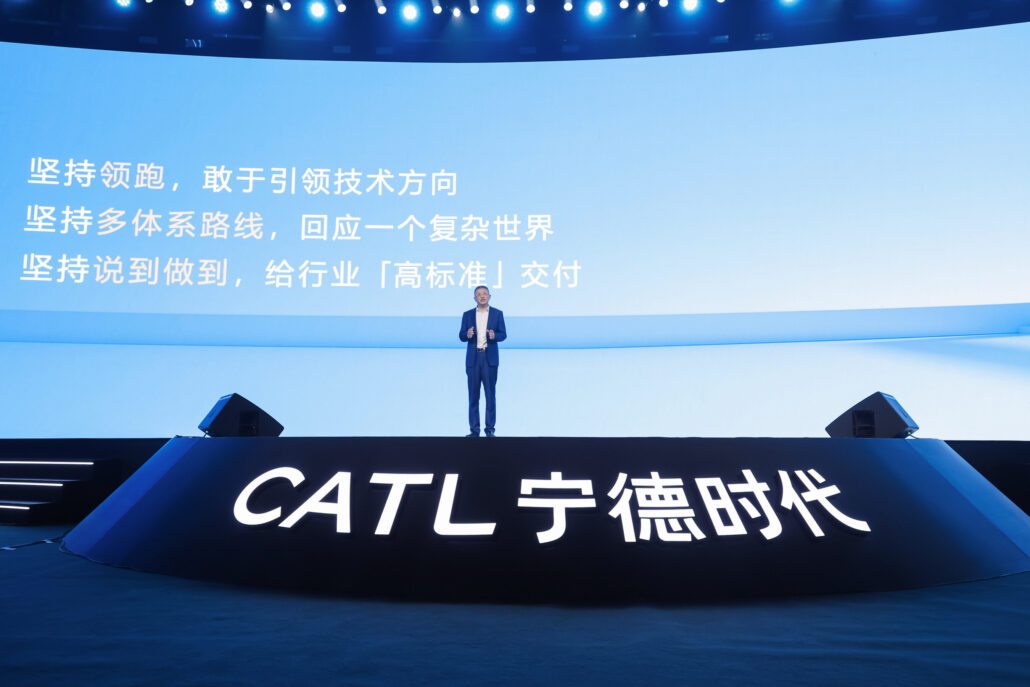
At a technology event in Beijing, the Chinese battery manufacturer CATL unveiled several new battery systems and infrastructure concepts. CATL is pursuing a strategy that focuses on using different battery chemistries in parallel rather than concentrating on a single technology. According to CATL, this approach is necessary to meet the diverse requirements of electric vehicles and energy systems.
Focus on multiple battery chemistries
CATL views lithium iron phosphate as having largely reached its limits in terms of energy density. Consequently, this chemistry is being designed more for fast charging. Nickel-manganese-cobalt systems remain relevant due to their high energy density. Additionally, CATL is developing sodium-ion batteries for low-temperature applications and stationary storage.
The third generation of the Qilin battery utilizes nickel-manganese-cobalt chemistry. It reportedly boasts an energy density of 280 Wh/kg. The maximum power output is 3 MW, for a battery pack weighing 625 kg. Compared to equivalent LFP systems, CATL claims the new battery is 255 kg lighter and 112 liters smaller.
The new Qilin Condensed Battery is also based on NMC chemistry, featuring a nickel-rich cathode and a silicon-carbon anode. It achieves 350 Wh/kg or 760 Wh/liter. According to CATL, the titanium alloy casing is thinner and lighter. This technology is said to enable ranges of up to 1,500 km.
The second generation of the Freevolt hybrid battery for plug-in hybrid models combines LFP and NCM chemistry in a hybrid structure. It is expected to enable ranges of up to 600 kilometers in all-electric mode.
Large-scale sodium-ion production coming soon
With the Naxtra battery, CATL is advancing sodium-ion technology. This chemistry does not use lithium and is said to offer advantages at low temperatures. According to the company, they have resolved several production issues, including problems with moisture control, gas formation, and material adhesion. Mass production on a GWh scale is planned for late 2026.