
Falling battery costs are a key driver of the continued growth of electric mobility. Yet this very trend could undermine the current recycling model. While batteries are becoming cheaper, they are simultaneously losing material value—with direct consequences for the economic viability of recycling.
Technological change in the battery market has accelerated over the past years: Within lithium-ion technologies, more cost-effective variants such as lithium iron phosphate (LFP) are gaining increasing importance, while nickel-manganese-cobalt (NMC) cells remain primarily in the high-performance premium segment. At the same time, new technologies such as sodium-ion batteries are coming into focus.
Shift in cell chemistries is changing the market
This development is confirmed by various market analyses. The International Energy Agency points out that as the share of low-cobalt cell chemistries increases, the economic conditions for recycling are also changing—and that regulatory mechanisms could play a greater role in the future.
According to BloombergNEF, prices for LFP batteries are significantly lower than those of NMC systems and have played a key role in driving down average battery costs in recent years.
A recent analysis by the GRS Batterien Foundation comes to a similar conclusion: According to the study, LFP could achieve a market share of around 60% by 2030 in the base scenario—and even up to 80% with faster technological progress. Looking ahead, sodium-ion batteries are also likely to gain increasing market share.
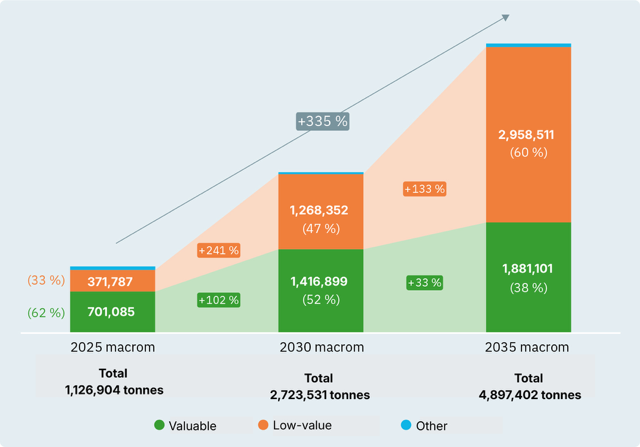
Forecast of demand trends for battery storage capacity in the EU by valuable and non-valuable cell chemistries (in tonnes) By 2035, the share of valuable batteries will decline significantly.
Why recycling has been economically viable so far
The existing recycling model for lithium-ion batteries has so far relied heavily on the recovery of valuable metals. Nickel and cobalt, in particular, play a key role in covering the costs of collection, transport, and processing.
Especially for NMC batteries, the material value is a central economic factor. Recycling therefore makes sense not only from an environmental perspective but can also be economically viable under certain conditions.
Less valuable materials, same effort
However, as cell chemistries evolve, this logic is shifting. LFP batteries largely do without nickel and cobalt, while sodium-ion batteries rely on even more cost-effective and globally available materials.
However, this shift does not affect all segments equally: According to forecasts, NMC batteries will primarily remain in the high-performance premium segment. This means that while the raw material-driven recycling model will remain viable in the premium segment for some time, it is coming under pressure particularly where the largest volumes are generated—in the mass market for electric mobility and in stationary storage systems.
The key point: The technical and logistical effort involved in recycling remains high—regardless of cell chemistry. At the same time, however, the economic return from the recovered materials is declining.
An analysis by the GRS Batterien Foundation also indicates that, with the increasing prevalence of cost-effective cell chemistries, existing revenue models could come under pressure.
Recycling risks becoming an unprofitable business
As a result, the existing balance between costs and revenues is shifting.
While recycling is currently supported in part by material revenues, it could become more dependent on external factors in the future—such as regulatory requirements or new financing mechanisms. The industry has long pointed out that business models in battery recycling must adapt to changing material structures.
The industry is thus facing a fundamental shift: away from a primarily raw material-driven approach toward more systemically organized circular models.
New business models and regulatory solutions are needed
In this context, regulatory frameworks and new business models are gaining importance. The EU Battery Regulation already focuses on extended producer responsibility and mandatory recycling targets.
In the future, recycling could evolve more toward a regulated system in which financing is no longer primarily based on material values but on mandatory contributions along the value chain.
At the same time, new approaches are emerging:
- Optimized collection and logistics systems
- Specialization in specific cell chemistries
- Integration of second-life applications
Uncertain forecasts, clear trend
However, it is difficult to predict how quickly and to what extent this development will take place. Forecasts regarding market development and the prevalence of individual cell chemistries vary considerably in some cases—as the GRS analysis itself points out.
Nevertheless, a clear trend is emerging—and industry experts estimate that the momentum is in some cases even greater than market models suggest, particularly for sodium-ion batteries. The transition to more cost-effective battery technologies is transforming not only production but also the logic of the circular economy.
Conclusion: A systemic shift rather than optimization
For the recycling industry, this means more than just adapting existing processes. Rather, it marks a fundamental system shift.
In the future, recycling will be determined less by the value of individual raw materials and more by regulatory requirements, industrial strategies, and the organization of functioning material cycles.
Consequently, the central question is no longer just how batteries can be recycled—but under what economic conditions this will happen in the future.
Sources:
Stiftung GRS Batterien / Macrom — „Entwicklung der Batteriezellchemien in der EU bis 2035″, March 2026
https://www.stiftung-grs.de/fileadmin/Downloads/Sonstige_Downloads/Marktstudie_Zellchemien_im_Wandel_GRS-PM.pdf
IEA — Global EV Outlook 2024, Kapitel: Outlook for battery and energy demand
https://www.iea.org/reports/global-ev-outlook-2024/outlook-for-battery-and-energy-demand
IEA — Recycling of Critical Minerals, Executive Summary
https://www.iea.org/reports/recycling-of-critical-minerals/executive-summary
BloombergNEF — Lithium-Ion Battery Pack Prices Fall to $108/kWh, December 2025
https://about.bnef.com/insights/clean-transport/lithium-ion-battery-pack-prices-fall-to-108-per-kilowatt-hour-despite-rising-metal-prices-bloombergnef
Fastmarkets — „European LFP recycling vital for future but facing economic barriers”
https://www.fastmarkets.com/insights/european-lfp-recycling-vital-for-future-but-facing-economic-barriers-lme-week/
C&EN / American Chemical Society — „Lithium-ion battery recycling goes large”
https://cen.acs.org/environment/recycling/Lithium-ion-battery-recycling-goes/101/i38