
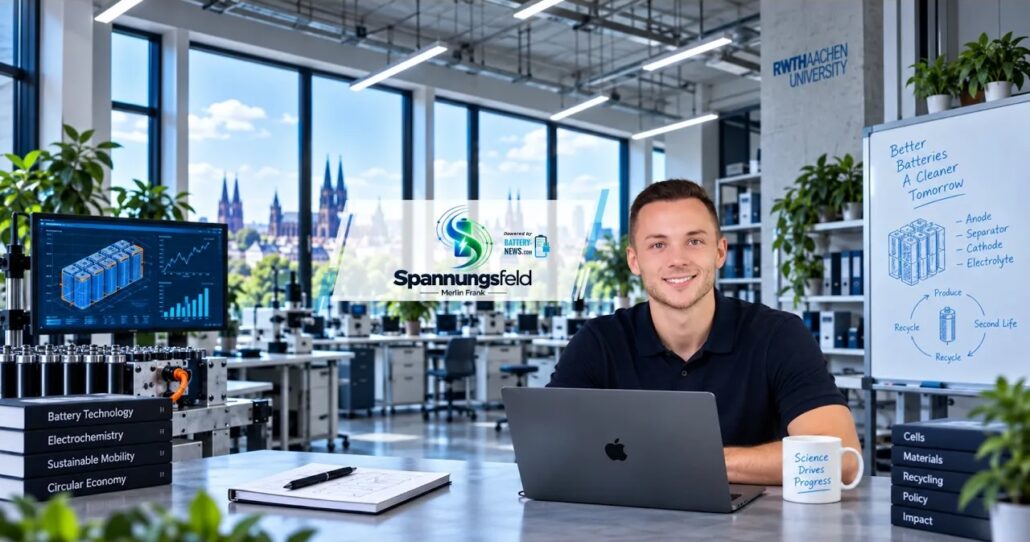
Battery technology is complex—and simple answers often fall short. Battery News is expanding its coverage with a new video format: On YouTube, battery researcher Merlin Frank explains what is behind the latest developments, drawing on data and scientific evidence while keeping the content accessible.
Whether the topic is service life, recycling, raw materials, or new cell technologies, batteries generate plenty of headlines—but not always enough context. That is where the new format comes in. Merlin Frank, a doctoral researcher at RWTH Aachen University, aims to explain what the numbers, studies, and technological developments actually mean.
Less hype, more data.
Batteries are no longer just a component of electric vehicles. They play a central role in mobility, energy supply, and industry—and are the subject of intense debate. Range, aging, raw materials, recycling, safety, and the global technology race involving Europe, China, and other regions regularly make headlines.
With the new video offering, Battery News will also cover these topics in a format that provides more room for data, background, and technical context. Merlin Frank will be the face of the series. The doctoral researcher at RWTH Aachen University wants to show what lies behind the numbers, studies, and technological developments.
Between Oversimplification and Technical Jargon
One challenge, in Merlin Frank’s view, is how battery topics are often communicated. At one end of the spectrum are highly simplified explanations; at the other are highly specialized technical articles that can be difficult to follow without substantial prior knowledge.
The new format is designed to bridge that gap.
“My aim is to combine the two: technically rigorous and data-driven, but explained in a way that viewers without extensive prior knowledge can follow,” says Merlin Frank.
Wherever possible, claims will not rest on isolated examples or personal assessments. Studies, market data, and Frank’s own analyses will provide the basis for putting figures and developments into a broader context.
That is particularly important when it comes to batteries, because many questions cannot be answered simply as “good” or “bad.” How sustainable a battery is depends, for example, on its cell chemistry, manufacturing, use, electricity mix, service life, and end-of-life recycling. Claims about technological competitiveness or raw-material dependencies also require context.
Rather than offering simple answers, Merlin Frank wants to make clear what conclusions the available data support—and where the evidence does not allow for a definitive judgment.
From Cell Chemistry to the Battery Market
The video format will cover a broad range of topics. Planned content includes foundational videos on subjects such as cell chemistries, battery design, aging mechanisms, and charging behavior.
Data-driven market analyses and manufacturer comparisons will also play an important role. Merlin Frank also plans to address current developments, including new battery technologies, recycling processes, manufacturing sites, and developments among European and Asian battery manufacturers.
The format therefore spans both foundational knowledge and current industry analysis.
On-location reporting is also planned for the future. Merlin Frank aims to visit research institutions, companies, and industry events to show technological developments where they are being created and put into practice.
Not Just for Battery Experts
The target audience is intentionally broad. The videos are aimed at technically curious viewers and EV drivers as well as students, engineers, and professionals working with batteries, electric mobility, or energy technology.
The key requirement is not a particular level of technical expertise, but an interest in understanding technological developments in greater depth.
Merlin Frank wants to preserve technical depth without assuming that viewers are already experts in electrochemistry or battery production. Complex concepts should become easier to understand without being simplified to the point that important distinctions or uncertainties are lost.
One Topic per Week
As a rule, one new video is planned per week. Most episodes will run about 10 to 20 minutes, while more extensive analyses may be longer.
The videos are intended to stay concise enough to address individual questions in a focused way while still leaving enough room for context and data.
The new offering expands Battery News coverage with a format for anyone who wants to go beyond the headline when it comes to batteries: less hype, more data—and more room to understand what is really happening technologically.