
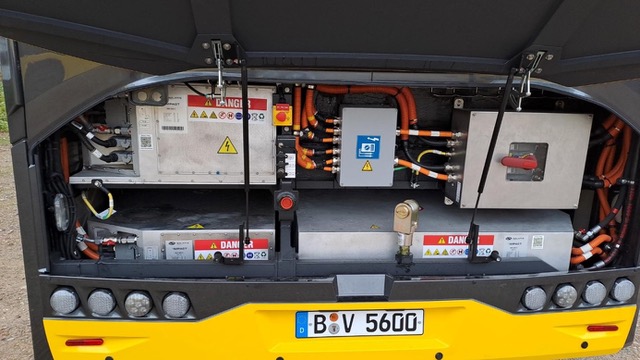
As public transportation becomes increasingly electrified, the management of traction batteries is taking center stage for transit companies. Berlin’s public transit authority BVG is therefore using digital battery passports from Dortmund-based technology provider Spherity for part of its electric bus fleet. The goal is to make operational data available in a structured format across the entire battery lifecycle—from use in service to second-life applications and recycling.
BVG already operates more than 300 electric buses with batteries of up to 700 kWh capacity. By the early 2030s, the fleet is expected to grow to around 1,500 vehicles. This will also place significantly higher demands on maintenance, condition monitoring, and documentation of high-voltage batteries in operation. To help manage these requirements, BVG is already testing the digital battery passport in 55 buses.
Data access via QR code
At its core, the digital battery passport is a structured dataset hosted in a decentralized, cloud-based infrastructure. Spherity relies on open standards and a decentralized identity architecture (SSI – Self-Sovereign Identity), which ensures that data access is traceable and tamper-proof. Authorized parties can access information via a unique identifier—in the case of the BVG, a QR code on the battery housing. This includes, among other things, data
- on the origin of the cells,
- on the chemical composition,
- on the carbon footprint, and
- on operating parameters such as charge cycles or temperature profiles.
For transit companies, such a data framework can help better plan maintenance measures and assess the condition of individual battery systems more transparently. At the same time, relevant information for later phases of use or recycling processes can be documented early on.
Relevance for regulatory requirements
Digital battery passports are also gaining importance in light of new European regulations. The EU Battery Regulation (BATT 2.0) and the Ecodesign Regulation (ESPR) stipulate that comprehensive information on the lifecycle must be available for certain battery categories in the future. This includes data on sustainability, material composition, and performance. For the BVG, this is not an abstract regulatory framework: its first 228 e-buses saved nearly nine million liters of diesel and approximately 30,000 metric tons of CO₂ between 2019 and 2024—figures that could be automatically documented and reported via the battery passport in the future.
Standardized data models can help companies meet these requirements and efficiently provide evidence for audits or sustainability reports. At the same time, new demands arise regarding IT integration, data quality, and access management.
Foundation for data-driven fleet management
In addition to regulatory aspects, transit companies also see potential in digital battery passports for operational fleet management. Manufacturers can provide additional technical documentation, such as maintenance manuals or schematics, in digital form. This allows service processes to be accelerated and information to be managed centrally.
Structured data exchange can also benefit authorities or testing organizations, for example during technical inspections or environmental assessments. However, this requires that interfaces be designed to be interoperable and that data protection and security requirements be met.
“The battery passport is not an end in itself—it becomes an operational tool. It provides transparency regarding a battery’s condition, origin, and compliance-related information, supports predictive maintenance planning, reduces manual effort, and facilitates compliance with regulatory requirements throughout the lifecycle,” says Ricky Thiermann, Head of Product Management at Spherity.
Focus on second life and recycling
In bus operations, traction batteries typically reach a stage after ten to 15 years at which their capacity is no longer sufficient for use in the vehicle. In many cases, however, they can still be used as stationary energy storage systems—a so-called second-life scenario that significantly extends their overall service life. Initial pilot projects are underway, for example, at a well-known discount store. Recycling, during which up to 95 percent of the materials can be recovered, only takes place at the end of the extended lifecycle.
A digital battery passport can provide relevant information on material composition or the so-called “state of health” during these later stages of use. For recycling companies, this can simplify process planning and help recover valuable materials more efficiently.
A cornerstone for transparent battery supply chains
With the increasing adoption of digital battery passports, a more comprehensive database is emerging along the entire value chain. This could enable transit operators, manufacturers, service providers, and recyclers to collaborate more closely.
At the same time, the example from Berlin shows that the practical implementation of such solutions involves organizational and technical challenges—such as standardizing data formats or integrating them into existing IT systems.
Nevertheless, as electric mobility gains momentum, the need for transparent information about batteries is growing noticeably. The experience gained so far with Spherity’s battery passports at BVG shows how digital battery passports can evolve from a regulatory requirement into a practical operational tool—and thus serve as a blueprint for other public transport operators in Europe.
Based on information from Spherity GmbH, the article was updated on April 20, 2026.
Sources:
https://www.bvg.de/de/unternehmen/nachhaltige-mobilitaet/flotte/e-mobilitaet
https://www.berlin.de/sen/uvk/mobilitaet-und-verkehr/verkehrsplanung/oeffentlicher-personennahverkehr/elektro-busse